
How the Decent Framework™ Compares
Interested in how Decent stacks up against your current governance model?
We've got you covered here.
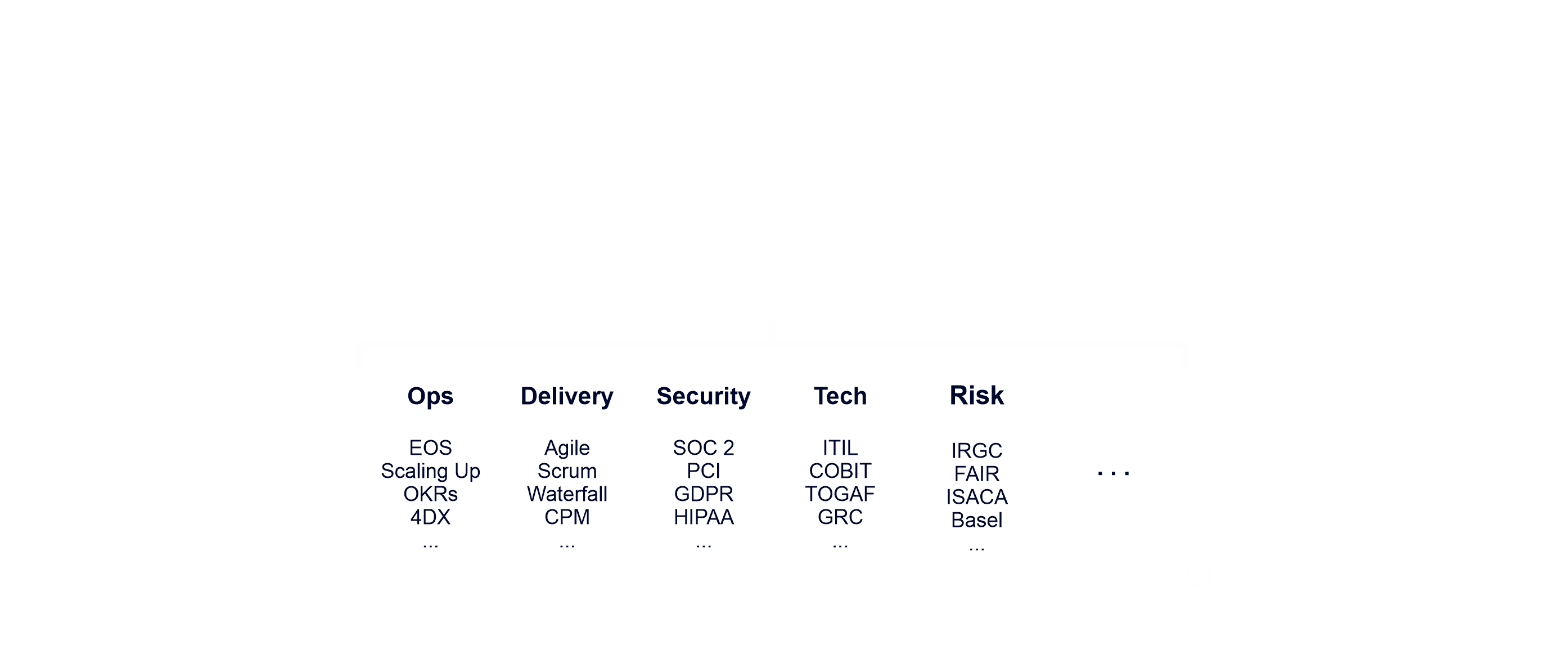
TL;DR
The Decent Framework™ is a top-level, over-arching governance framework that spans every operational aspect of the business - there isn't a true comparison on the market today.
Many times, Decent makes whatever you use today more effective - by offloading burdens that your current framework wasn't meant to handle.
Overall - the Decent Framework™ is leveraged to drive value as a single control layer.
Operating Models
(n): the strategy by which an organization makes investments.
Common operating models:
- Product Operating Model (POM)
- Capability Operating Model
- Platform Operating Model
- Functional Operating Model
- Project Operating Model
- Customer Segment Operating Model
Decent leverages the Structural Operating Model™ to make balanced investments across the entire company, based on value, rather than focusing on a specific niche.
Methodologies
(n): rigid, procedural approaches to achieving certain outcomes.
Operational Methodologies
Common examples:
- Entrepreneurial Operating System (EOS)
- OKRs
- Lean Six Sigma
By contrast - Decent does not prescribe for day-to-day operations, but focuses on the infrastructure that powers day-to-day operations: decision-making, ownership, value, and scope. In most cases, companies may continue using whatever operational methodology they prefer alongside the Decent Framework™.
Delivery Methodologies
Common examples:
- Agile
- Waterfall
- Hybrid
The Decent Framework™ is value-oriented, focusing on the inputs and outputs rather than the means of delivery. Decent leaves delivery methodology up to each owner to choose what is best for their given scope.
Transformation Methodologies
Common examples:
- Kotter’s 8-Step Change Methodology
- Prosci ADKAR
- Consulting Firm Methodologies
Similarly, Decent is focused on achieving structural milestones - as opposed to the process used to achieve it. However, the Decent Framework™ does provide tools to achieve change - so it could be used in place of other transformation methodologies.
M&A Methodologies
Common examples:
- Traditional Deal Lifecycle
- PMI
- Day 1 / Day 100
- Consulting Firm Methodologies
The Decent Framework™ does not provide tactical guidance for integrations. Instead, Decent provides built-in tools for managing value - and consequently, integrations. This means Decent can be used plan and execute integrations through structure - rather than relying on generic playbooks.
Frameworks
(n): a set of flexible, guiding principles typically accompanied by specific tools or recommendations.
Technology
Common examples:
- FinOps
- DevOps
- ITIL
- COBIT
- TOGAF
Most of these pair well with the Decent Framework™, as they typically fit well within specific scopes - or act as inputs for specific units of value. Expect to gain additional clarity on ownership and boundaries for technology frameworks with Decent.
Organization
Common examples:
- McKinsey 7S
- RACI
- SPAN of Control
Though similar in some aspects, the Decent Framework™ is less prescriptive on specific responsibilities and more concerned with boundaries. All scope officers start with full autonomy within their domain, and are then restricted by covenant.
M&A
Common examples:
- Deal Thesis
- Synergy Topology
- Build vs. Buy
- Portfolio Rationalization
These filters make excellent additions to the Decent Framework™, but are more focused on strategy. Decent is strategy-agnostic and unlocks standardized analysis that can support any number of portfolio strategies.
Frameworks at Large
Overall - the Decent Framework doesn't impose milestones, target states, or processes. Instead, it provides a standard definition for "value" - then provides tools for how to create, manage, visualize, and measure it.
In most cases, Decent can accommodate existing frameworks - and likely increase their effectiveness.
Compliance and Regulation
(n): rules for running a business
See also: Legal, HR, Safety, Risk, etc...
Common examples:
- FDIC
- PCI
- HIPAA
- SOC 2
- GDPR
Decent provides the necessary infrastructure to make business and continuity decisions outside of these layers.
In other words, Decent provides a built-in prioritization and escalation path that determines what supersedes what - and who gets the final say. Furthermore, in heavily regulated industries, the Decent Framework™ can significantly reduce approval processes and increase velocity.
It's not about circumventing the system - it is about understanding requirements, proper scoping, and accurate application of controls. This is where the Decent Framework™ shines.
Final Note
If your team has struggled with velocity, excessive meetings, multiple approval requirements, or an endless call for alignment - rest assured, you're in the right place.
The Decent Framework™ doesn't rip anything out, or significantly overhaul the organization. It merely sets boundaries and expectations, then provides tools to move forward from there.